
L-CARNITINE IN VIALS
Description
What is L-Carnitine 500 (Astera Labs)?
L-Carnitine is not a hormone and not a fat burner. It is a transporter, and the injectable form exists because the oral one is barely absorbed.
Also sold as levocarnitine or L-carnitine tartrate.
L-carnitine carries fatty acids into the mitochondria, where they can be burned. It does not decide whether they get burned, it only handles the transport. That distinction is the whole story: if there is no energy deficit, nothing is oxidised no matter how efficient the transport is.
L-Carnitine benefits
- Far better absorbed than oral L-carnitine, which is the reason the injectable exists
- Better evidence for reduced muscle soreness and faster recovery than for fat loss
- No suppression, no aromatisation, no cycle and no post-cycle therapy
- Can be run continuously rather than in blocks
L-Carnitine dosage
- Standard
- 500 to 1000mg per day, which is 1 to 2ml
- Timing
- Pre-workout on training days
- Frequency
- Daily
- Route
- Intramuscular
- Cycle length
- No limit, it can be run continuously
One millilitre is 500mg. There is no cycling requirement and no reason to come off, because nothing is being suppressed.
It does nothing without a calorie deficit. L-carnitine improves the transport step, not the decision to burn fat. Run at maintenance calories it will not reduce body fat, and that is the single most common disappointment with it.
Package content
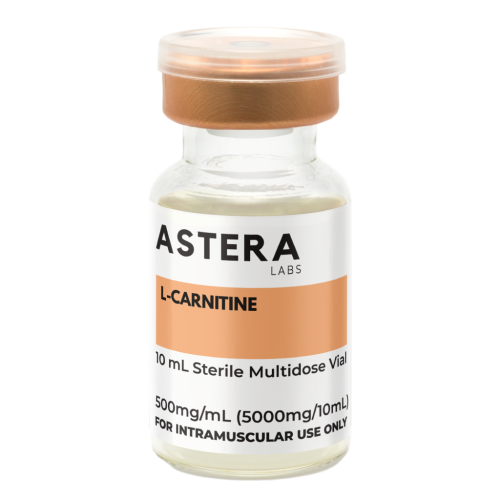
- Vial
- 10ml sterile multidose
- Strength
- 500mg/ml
- L-carnitine per vial
- 5000mg
- Volume
- 10ml
- Brand
- Astera Labs
At 500mg a day one vial covers ten days.
Store below 30°C. Protect from light. Do not freeze. Keep out of reach of children.
Who is L-Carnitine for?
People already in a deficit who want the transport step working properly, and people training hard enough that the recovery effect matters. It pairs sensibly with a cut rather than replacing one.
It is the wrong purchase for anyone expecting it to reduce body fat on its own. That is not what it does, and no dose changes that.
How to use L-Carnitine
Intramuscular injection, usually pre-workout on training days. Rotate sites. The injection technique guide covers it.
Frequently asked questions
Does L-carnitine actually burn fat?
Not by itself, and this is where most of the disappointment comes from. L-carnitine transports fatty acids into the mitochondria. Whether those fatty acids are then burned depends on whether your body needs the energy.
In a calorie deficit it helps that process run efficiently. At maintenance it does very little, because there is nothing driving the oxidation in the first place.
Why inject it instead of taking capsules?
Absorption. Oral L-carnitine is poorly bioavailable, with a large part of an oral dose never reaching circulation at all, and much of what does gets broken down by gut bacteria.
Injecting bypasses all of that. It is the only reason the injectable version exists, and it is a genuine one rather than a marketing angle.
Do I need to cycle it?
No. L-carnitine is a naturally occurring compound and it does not suppress anything, so there is nothing to recover from and no reason to come off.
No post-cycle therapy, no bloodwork requirement, no cycle length limit.
Is it banned in tested sport?
L-carnitine itself is not on the prohibited list. The complication is the route: intravenous infusions of more than 100ml per 12 hour period are prohibited as a method, whatever the substance.
An intramuscular injection of one or two millilitres does not come close to that limit. If you compete tested, check the current rules yourself rather than relying on any shop to be up to date.
What does it actually do that is well supported?
Recovery, more reliably than fat loss. The clearer findings are around reduced muscle soreness and markers of muscle damage after hard training.
That is a less exciting claim than the one usually made for it, and it is the more honest one.
All products are supplied exclusively for research and evaluation purposes and are not positioned as medical treatments or health solutions.