TB-500 (Thymosin Beta-4)
Description
What is TB-500 (Thymosin Beta-4)?
TB-500 works on the other half of tissue repair from BPC-157: getting the repair cells to where the damage is. The two are almost always run together.
Also sold as TB-500 or thymosin beta-4.
TB-500 is a synthetic fragment of thymosin beta-4, a protein involved in tissue repair throughout the body. It regulates actin, which is what cells use to move, so its main effect is helping repair cells migrate to damaged tissue. It also promotes new blood vessel formation and appears to reduce scar tissue and improve flexibility.
TB-500 benefits
- Helps repair cells reach damaged tissue, which is a different mechanism from BPC-157
- Reported to reduce scar tissue formation and improve flexibility
- Works systemically rather than needing to be injected at the site
- Twice-weekly loading then weekly maintenance, so few injections
- Not androgenic, so nothing is suppressed and no post-cycle therapy applies
TB-500 dosage
- Loading, weeks 1 to 4
- 2 to 2.5mg twice weekly
- Maintenance
- 2mg once weekly
- Route
- Subcutaneous, systemic
- Run length
- 4 to 6 weeks loading, then maintenance
- Often paired with
- BPC-157
- Per vial
- 2mg
The protocol is a loading phase of twice-weekly injections for around four weeks, then a lower maintenance dose. Unlike BPC-157 it works systemically, so there is no need to inject near the injury.
It is almost always run alongside BPC-157, which handles a different part of the repair process.
Reconstitute with bacteriostatic water. The reconstitution guide covers the method and the dosage calculator works out how much water to add for the dose you want.
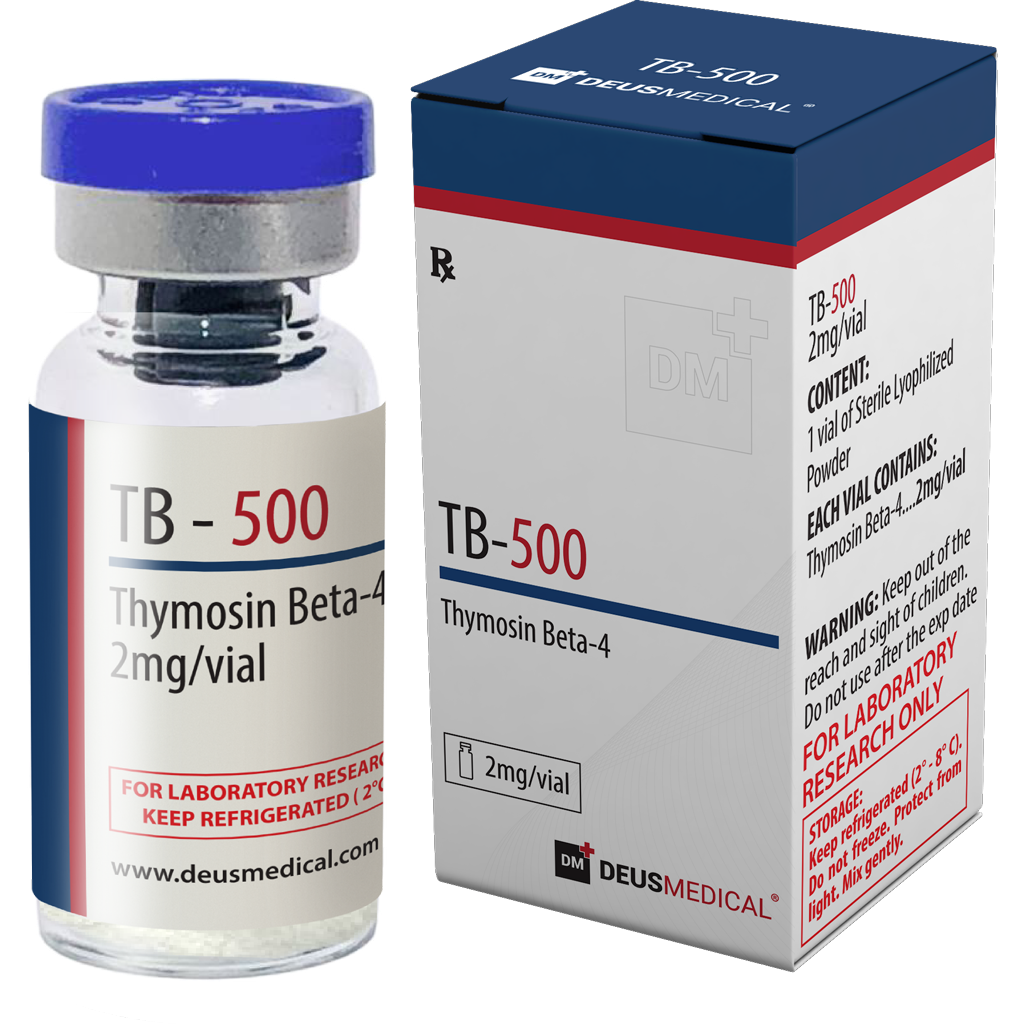
Package content
- Vial
- 1 vial of lyophilised powder
- Peptide per vial
- 2mg
- Form
- Lyophilised powder for reconstitution
- Diluent
- Bacteriostatic water, sold separately
- Brand
- Deus Medical
One vial is one loading dose, so a four week loading phase needs eight.
Store below 30°C. Protect from light. Do not freeze. Keep out of reach of children.
Who is TB-500 for?
People recovering from soft tissue injuries, particularly where stiffness and scar tissue are part of the problem rather than just the original damage.
Running it alone is less common than running it with BPC-157. The combined vial puts both in one product if you would rather not manage two.
How to use TB-500
Reconstitute with bacteriostatic water and refrigerate once mixed. Inject subcutaneously into the abdomen, twice weekly during loading and once weekly afterwards. It works systemically, so the site does not matter.
Frequently asked questions
Is there human evidence for this?
Not in the form of controlled trials, and it is worth being straight about that. The animal work is extensive and the results in rats are consistent and impressive, particularly for tendon and gut healing.
What is missing is the human trial that would turn that into medical use. Plenty of people report it works. We would rather tell you where the evidence actually sits than imply something that has not been shown.
How is it different from BPC-157?
Different parts of the same job. BPC-157 mostly promotes new blood supply into damaged tissue. TB-500 mostly helps repair cells migrate to where they are needed and appears to reduce scar tissue.
That is why they are run together rather than as alternatives. TB-500 also works systemically, where BPC-157 is often injected near the injury.
Do I need to inject it near the injury?
No, and that is a practical advantage over BPC-157. TB-500 works systemically, so anywhere subcutaneous is fine.
That makes it the easier of the two to use for injuries in awkward places.
What is the loading phase for?
To build tissue levels up faster at the start. Two injections a week for around four weeks, then a lower maintenance dose once weekly.
Going straight to maintenance is slower to do anything. The loading phase is where most of a vial budget goes.
Can I run it with BPC-157?
Yes, and most people do. It is the standard healing stack because the two mechanisms complement rather than overlap.
There is a combined vial if you would rather buy one product.
All products are supplied exclusively for research and evaluation purposes and are not positioned as medical treatments or health solutions.